
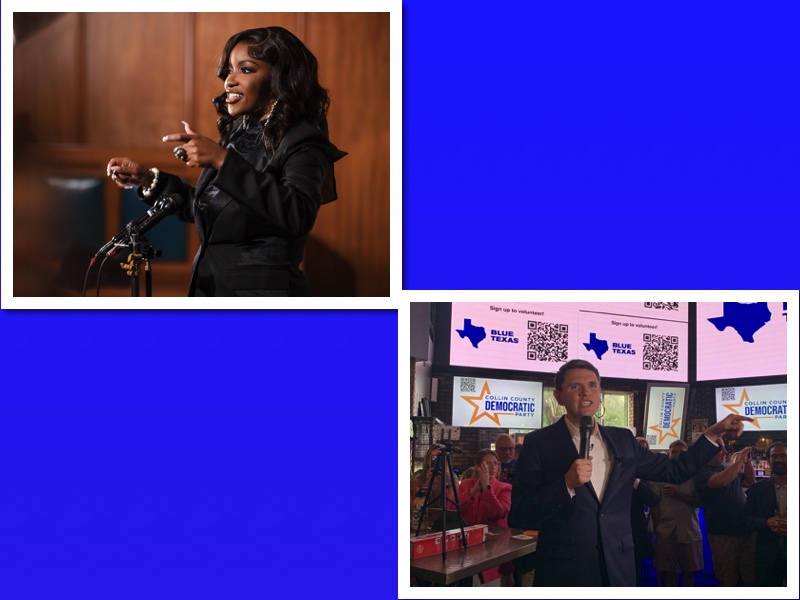
Nathan Hunsinger, Emma Rub

Audio By Carbonatix
It may be a while before the comedians Bowen Yang and Matt Rogers are willing to wade into the world of politics again.
In early January, the hosts of the pop-culture podcast “Las Culturistas” found themselves debating the problems plaguing Democrats across the country and pontificating on the idea of “electability.” Turning to Texas, the hosts encouraged listeners not to “waste their money” on the campaign being waged by Dallas’ own U.S. Rep. Jasmine Crockett, who joined the Senate primary in December.
The backlash was swift, drawing apologies from both Rogers, who vowed to “be better,” and Yang, who pledged to use his platform “more responsibly” in the future. If the incident proved anything, it was that the internet’s appetite for conversations about Crockett, who in her two terms in Congress has proven a knack for saying the witty things that make online fans go wild, is insatiable.
The discourse surrounding Crockett and her primary opponent, state Rep. James Talarico, has been largely driven by online content creators, some based in Texas and many not. And recently, it has gotten ugly.
“I have just been really gut-wrenched at what this primary has become, and it’s not even because of words that are consistently coming out of each candidate’s mouth,” Olivia Julianna, a Democratic social media influencer who has 325,000 followers on X and 173,000 followers on Instagram, told the Texas Tribune. “We would all do a lot of good if every once in a while we realized social media is not real life.”
Earlier this month, the influence that online creators can wield became clear when local congressman and former Senate candidate Colin Allred went on the attack against Talarico. His grievance with the representative stemmed from a TikTok video made by a Dallas-based content creator who claimed that Talarico, in an off-the-record conversation, referred to Allred as a “mediocre Black man.”
Allred was livid, telling Talarico via social media video to not “come for me unless I send for you.” He also used the clip to formally endorse Crockett.
Talarico has denied that he made the comments as the influencer presented them in a TikTok video viewed 97,000 times.
“I described Congressman Allred’s campaigning as mediocre — but his life and service are not. I would never attack him on the basis of race,” said Talarico in a statement. “I understand how my critique of the Congressman’s campaign could be interpreted given this country’s painful legacy of racism, and I care deeply about the impact my words have on others.”
Allred has since doubled down on his insistence that Talarico should have apologized for the comments, and Crockett has suggested that those who have voiced disbelief over the claim are biased because the content creator who made the initial video is a Black woman. Liberal content creators have only fanned the flames of the outrage.
Those who openly support Crockett have accused Talarico’s supporters of racial bias. Talarico’s fans have emphasized that the candidate denied making the comment at all and point to the unsubstantiated nature of the claim. On both sides, online armies have risen to defend their chosen candidate, resorting to low blows and attacks.
“It’s not surprising that [candidates] are aware of what’s going on in the online social media space, but I do think it is interesting that we’re kind of seeing that kind of bleed over [into campaigning],” Broderick DeBettignies, a graduate student and teaching assistant at the University of Iowa who has taught a class focused on the intersection of politics and social media, told the Observer. “We know that misinformation is a major issue with social media content and the effects that that can have on folks.”
Connecting With the Youth
Last summer, a national survey found that increasingly young people are turning away from politics.
Adults 18 to 29 are less likely than their older peers to view voting as important, the study, conducted by The Associated Press-NORC Center for Public Affairs, found. They are less likely to follow political news and more likely to feel apathetic about issues such as the economy and health care.
But for politically inclined young people, online forums have emerged as one of the fastest ways to stay up to date on what is happening in Washington and across the country, and political parties have sought to tap into that influence. Ahead of the 2024 elections, the Democratic Party granted more than 200 influencers media credentials at the Democratic National Convention as part of a broader push to bring more young people into the party. NPR reports that the content created by those individuals brought in more than 350 million views.
Social media is the leading news source for 74% of Gen Z Americans, according to a January study by Johns Hopkins researchers, much higher than the 58% of millennials, 37% of Gen X, and 24% of boomers who report using the apps for news.
“Especially for young folks, we’ve seen a lack of trust in a lot of these kinds of legacy media sources,” DeBettignies said. “They’re not really tuning into the news at night, let alone like turning on CNN or Fox. … We’re seeing that this is an important way to reach folks, especially younger voters.”
In Texas, creators like @HowdyPolitics offer an inside track on the state Legislature and high-profile races, such as the one between Talarico and Crockett. A video that “spills the tea on the behind-the-scenes of the Senate primary” has been viewed 217,000 times; a response to the “Las Culturistas” controversy has been viewed 329,000 times.
Keith Edwards, a political media personality from outside Texas, has emerged as a leading champion of Talarico on X, where he has nearly 171,000 followers. After the Super Bowl, Edwards accused the Crockett campaign of using artificial intelligence in an advertisement that ran during the game in a tweet that has been viewed nearly 500,000 times. The Crockett campaign has not expressly denied that AI was used in the ad’s creation.
As these influencers make their preference for one candidate over the other clear, they seem to be attempting to sway their broader audiences in that direction. But in Texas, at least, campaigns and the state Democratic Party claim this is happening organically. A spokesperson for the Crockett campaign told the Texas Tribune that the campaign does not pay influencers to create content about it; the Talarico camp made the same claim to the Austin American-Statesman.
Even the broader state party has denied using the tactic, even as the national party has embraced it.
“The Texas Democratic Party does not pay influencers. While we are active on social media and utilize digital advertising as part of our strategy, our communications are rooted in facts, truth, and Democratic values, so we don’t have to fret over communications ethics,” Texas Democratic Party Executive Director Terri Burke told the Observer in a statement. “Individual candidates may choose to work with influencers or utilize television advertising depending on their specific budgets across Texas’s 19 media markets. Ultimately, there are many ways to communicate with voters, and people will engage with the channels they prefer.”
Fretting Over Ethics
In the mid-2010s, names like Candace Owens, Tucker Carlson and Charlie Kirk emerged as the original political content creators. A majority of these early adopters were conservative, giving the GOP the lead in the race to go online.
In recent years, the rise of the niche, liberal political influencer has led to a “diversification and almost democratization” of content across social media, DeBettignies said. Politicians have leaned on these creators in part because of the “relationship of trust” they maintain with their followers, but that relationship largely hinges on the honor system.
“Algorithms in social media tend to create echo chambers. They tend to worsen polarization,” DeBettignies said. “What I always tell folks is you have to take the information that you’re gathering with a grain of salt. You have to think about whether this source is reputable. … There can be some opaqueness or a lack of transparency around who is funding this [content].”
While it remains up to the viewer to determine a particular influencer’s motivation for creating the content they post, there are indications that watchdogs have caught on to the ethical problems this opacity can pose.
After it was revealed that Gen Z social media influencers were being paid to post positive content in support of Attorney General Ken Paxton during his impeachment hearing, the Texas Ethics Commission adopted a new rule requiring social media creators to disclose when they are paid for political advertisements. Any payments over $100 must be reported, the commission voted. Some skeptics worried that the new ordinance was too focused on cracking down on individual influencers, rather than the groups that fund them.
As news moves to online platforms, some strategists warn that content creators can burn a candidate just as quickly as they can fuel them. In the case of the TikToker who claimed Talarico described Allred as a “mediocre Black man,” the creator noted that the conversation had been off the record. In traditional journalism, that would have made the quote inadmissible. For a content creator, though, “off the record” may only have as much meaning as a particular influencer is willing to give it.
“There are no codes of ethics that you as a member of the press and free media abide by,” Dallas Jones, a Democratic strategist, told the Texas Tribune. “[Influencers] are not beholden to these things, so they can get out and use whatever four-letter words they can get out and say.”
