Courtesy of City of Garland

Audio By Carbonatix
The Flats, Garland’s original free-standing African American community, no longer exists in a tangible sense. Its buildings are gone, and few of its residents remain. Still, it played a key role in Garland’s development in the first half of the 20th century before it was bulldozed off the map in the 1960s.
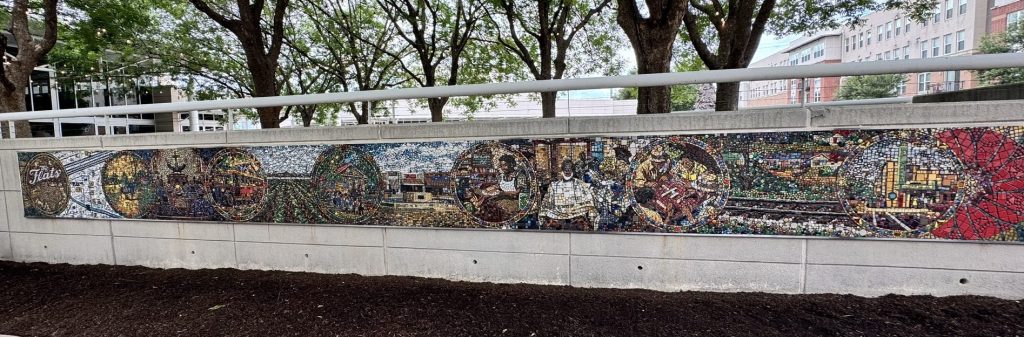
Now, Garland wants to give The Flats a new symbol for remembrance. On June 20, the city will host a dedication ceremony for “The Flats – A Legacy Installation,” featuring a permanent 36-foot mosaic commissioned for the project on the side of the Granville Arts Center. The dedication ceremony is hosted by The Atrium (300 N. Fifth St., Garland) at 4:30 p.m. Additionally, a Texas Historical Commission marker has been placed at the original site of The Flats, along with five interpretive panels providing insights into the community’s history.
Amy Rosenthal, Garland’s cultural arts director, says the project has been in the works for years and is already generating interest.
“We’ve had so many visitors come by that didn’t know about these stories, that didn’t know about the businesses or about the school,” Rosenthal says.
City of Garland
To be fair, few people know any stories about The Flats. Garland historian Emily Chavez took on the challenge of piecing together the community’s history, but realized quickly that very little of it had been documented. It’s a known issue in research on communities like The Flats, which was populated by Garland’s African American community in the 1900s. Major newspapers paid them little mind, and attempts have even been made to erase these communities from the history books.
For the project, Chavez relied on census records, the memories of still-living former residents of The Flats (now in their 90s), and the descendants of former residents to guide research into the community. They were able to locate photos of the community from its heyday and piece together its story from the 1910s through its demolition.
African Americans were not able to own homes in the area where The Flats stood (near the downtown square), according to Chavez, so the community was made up of wooden rental houses commonly known as “flats,” giving the area its name. Thriving Black-owned businesses arose, and the Colored School (the school’s official name) and the Lucy Hughes A.M.E. Church, the first African-American place of worship in Garland, gave the community a distinct identity.
For decades, the community grew, buoyed by manufacturing businesses that moved to Garland during World War II. The growth was a blessing and a curse, providing an economic engine for Garland but ultimately spelling doom for The Flats. The community outgrew the school’s original site, and it was relocated to East Garland. Black residents were allowed to buy land in that part of the city (as long as they built their own houses), and many followed the school east. Those who stayed lived in homes that were demolished for safety reasons in the 1960s.
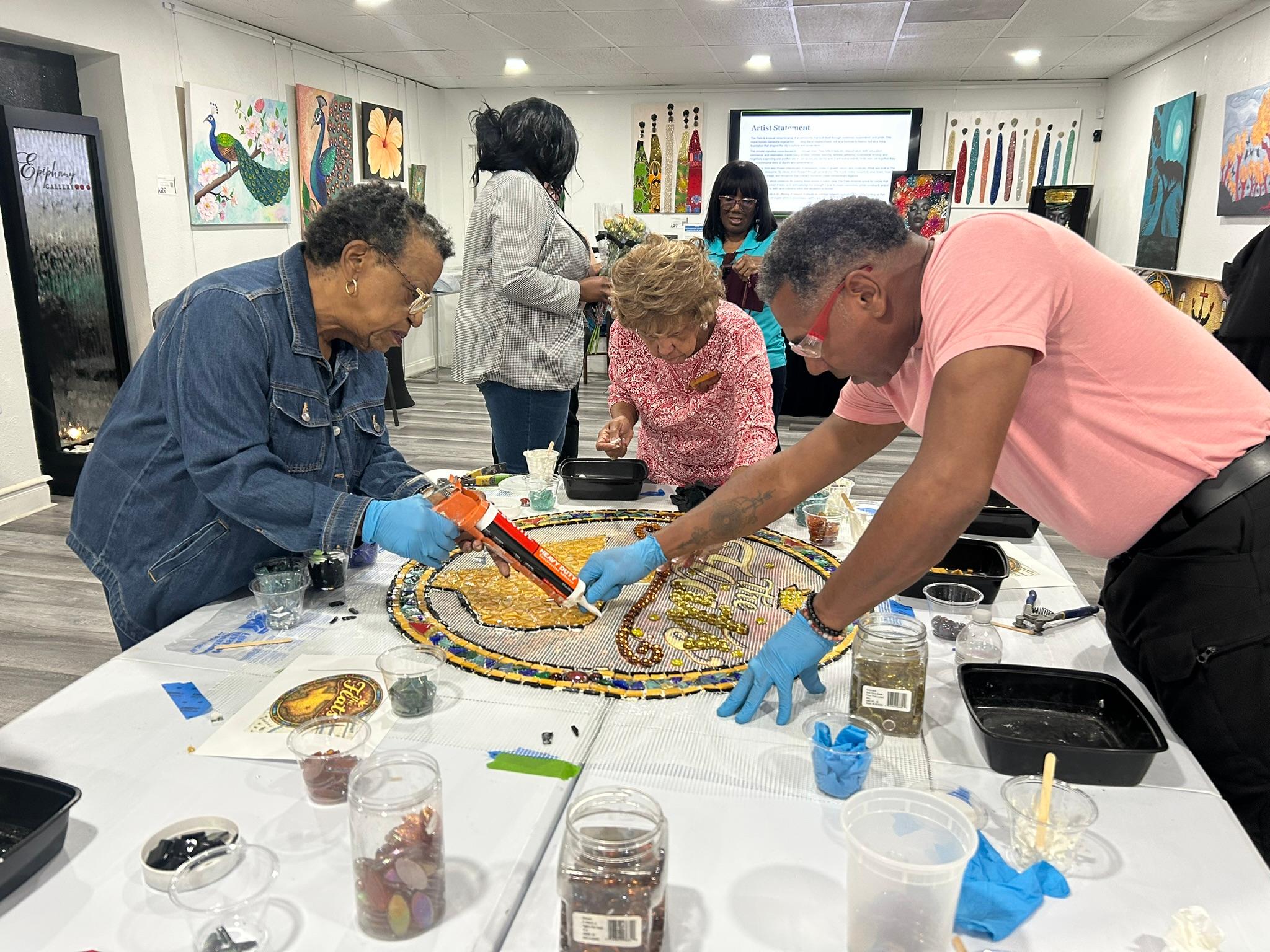
Artist Reginald C. Adams was commissioned to convert Chavez’s research into a mosaic for the city. Since 2021, Adams has created 15 different pieces honoring historic African-American communities in different cities. For the piece celebrating The Flats, he worked alongside a collection of artists, including five full-time residents, to lay more than 20,000 tiles. They also hosted a community workshop where residents could contribute to the project. It took a lot of time and effort to bring the story of The Flats, which is depicted in 15 vignettes, to life.
Courtesy of City of Garland
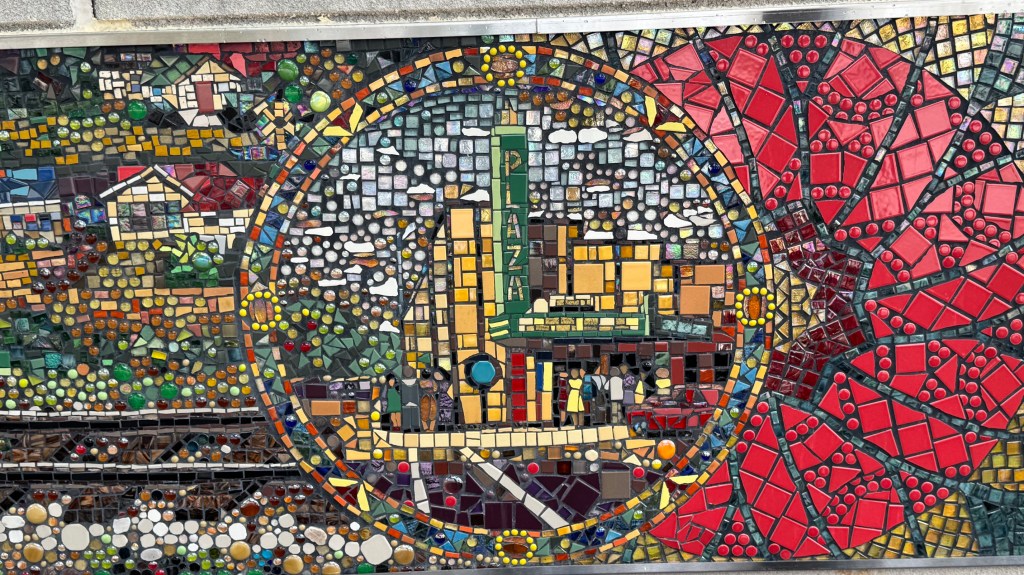
“Each of the scenes reflects a different facet of The Flats,” Adams says. “From a historic map to a grandmother and her granddaughter walking down a dirt road to the social life through the Plaza Theater and couples playing dominoes.”
The works also included the local barbershop in one of the scenes, which Adams says functioned as a town hall.
Beyond the art itself, Adams is interested in pairing his work with technological innovations. “The Flats – A Legacy Installation” allowed him to bring his work to life in an entirely new way. Using an app called Artivive, visitors can scan the mural to view an augmented reality experience in which the characters move around as a narrator explains the significance of each scene. Four songs were also commissioned to serve as the project’s soundtrack, further enhancing immersion. A dedicated website was created to host the experience online, significantly expanding the project’s reach.
“Someone who may never be able to go to Garland or to The Flats can still experience the mural in a much more interactive, educational and engaging way,” the artist tells us.
As involved as the project is, it only scratches the surface of The Flats’ story.
“There’s so much more personality and personal touches that we could add to it… so we’re hoping to do a bigger exhibit that shows all of that,” Chavez says.
From nearly forgotten to front-and-center in the city’s upcoming Juneteenth celebration, the efforts to recognize The Flats represent a major undertaking for Garland in terms of reckoning with its past and celebrating the people who made it what it is — especially those whose contributions have gone underrepresented by the history books.