txredistricting.org

Audio By Carbonatix
Texas’ fight over its congressional and legislative boundaries isn’t over. Not by a long shot.
On Friday afternoon, the U.S. Supreme Court agreed to hear Perez v. Abbott, the state’s years-long fight with voting rights organizations that claim that Texas’ black and Latino populations have been unconstitutionally packed into some districts while being drawn out of others.
The court’s decision is a small victory for the state’s Republican leadership, which has sought to delay a pair of 2017 rulings in lower courts requiring that two congressional and nine legislative districts in Texas be redrawn, potentially before the 2018 election. The Supreme Court had previously stayed both of those rulings, which threw out portions of maps that were redrawn in 2012 and 2013, as the case initially made its way through the federal courts.
“We are eager for the chance to present our case before the U.S. Supreme Court, which ordered the district court in San Antonio to draw lawful congressional and House maps in 2012 that the Legislature adopted in 2013 and used in the last three elections,” Texas Attorney General Ken Paxton said. “The lower court’s decisions to invalidate parts of the maps it drew and adopted is inexplicable and indefensible.”
Dallas state Rep. Rafael Anchia, chairman of the Mexican American Legislative Caucus, one of the plaintiffs in the suit, said he hopes the court will rule as quickly as possible, so voters votes will count as much as they should.
“Texans deserve for their votes to count. After six years in litigation, we welcome swift action from the highest court in the land. We are hopeful that the court will provide justice to voters and agree that discrimination will not be tolerated in our elections,” Anchia said in a statement.
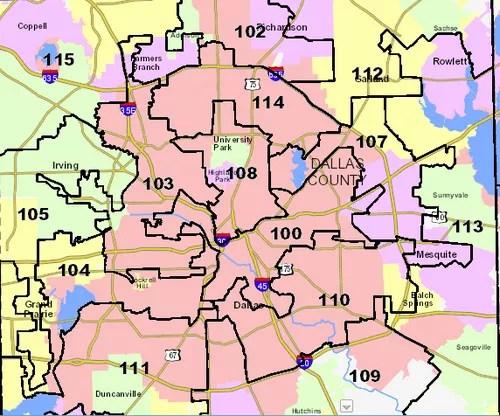
Dallas County’s Texas House map
txredistricting.org
Anchia’s district was one of the three in Dallas County singled out by the three-judge panel in San Antonio that initially ruled the legislative map to be illegally gerrymandered. House Districts 103 and 104 — represented by Anchia and Robert Alonzo — were drawn, the panel said, in order to concentrate Latino voters and give Grand Prairie Republican Rodney Anderson a better chance to keep his seat in House District 105.
While the Supreme Court can’t change the past, Anchia said, the process must be taken out of Texas Republicans’ hands.
“Millions of votes have been cast under unconstitutional maps and we are preparing to start the process all over again in a few short years. It’s clear that the legislature cannot be trusted to put the best interest of Texans first,” Anchia said.